
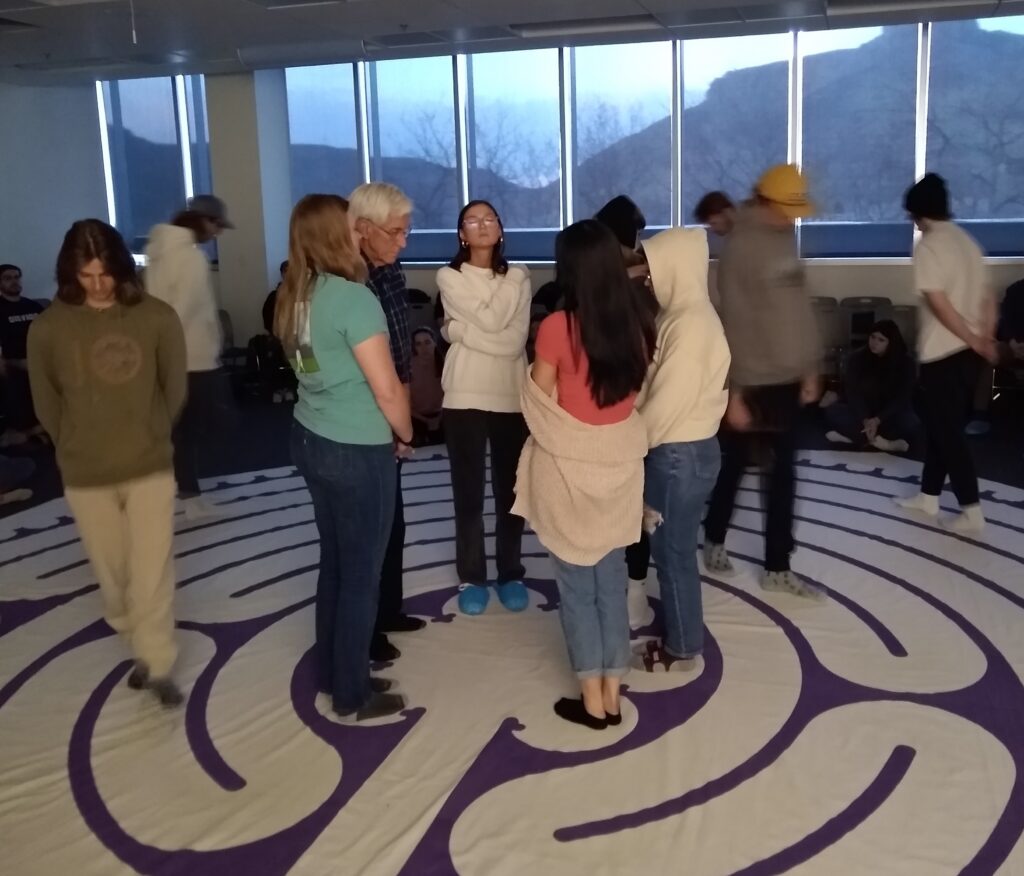
In the class Science and Spirituality that I taught at the Colorado School of Mines, we walk the labyrinth. We walk over a thick line on a carpet that in circular segments brings us to the center of the circles. The line does not split, there are no choices to make, this is not a maze. At face value this activity is not particularly exciting or challenging. But walking the labyrinth is for many of us an activity that takes us deeper into ourselves. The labyrinth takes us to a deeper level, and it is this deepening that gives meaning to walking the labyrinth.
In my newsletter Living with Joy I wrote about finding joy in life. But when faced with a challenge—think of the loss of a loved one, a job, or our health—it can be difficult to find joy. And sometimes in life we are not drawn to joy, but we are drawn to a deeper experience. This is where meaning becomes important. But what does the word “meaning” exactly mean?
In my newsletter life is like an onion I describe the different layers in our life, from the superficial aspect of events and issues in our outer life to more fundamental aspects of our existence. I think of meaning as that which connects these different layers in our life. I was a teenager when I lost my mother. This was a devastating loss, especially since I was emotionally not capable to deal with this. But over the years, this loss became deeply meaningful because it created a deep awareness and appreciation in me that life is transitory, and that it is not to be squandered on outward objects and petty ambitions. It is that awareness that gave meaning to a loss that was otherwise incomprehensible to me.
In his book Man’s Search for Meaning, Viktor Frankl describes his experience in concentration camps during the Holocaust. The main point he makes is that in the horrifying circumstances in the concentration camps, it was a sense of meaning that was crucial for the survival of prisoners. At one point, Frankl prioritized his loyalty to a group of fellow prisoners whose fate seemed to be sealed, over his own immediate safety. Because of this choice for meaning—expressed in loyalty—he survived to tell his story.
Meaning gives depth to an event or circumstance; it lifts us beyond the mere event of activity by placing it in a deeper context. That presumes, of course, that one is aware of the different layers in our life. On the other hand, a loss or challenge may prompt us to see beyond a circumstance or event and discover the deeper layers in our life, so that we can experience the meaning of what happens. The early loss of my mother is an example of this.
In her book My Grandfather’s Blessings, Rachel Naomi Remen writes the following about meaning:
“Most of us lead far more meaningful lives than we know. Often finding meaning is not about doing things differently; it is about seeing familiar things in new ways. When we find new eyes, the unexpected blessing in the work we have done for many years may take us by surprise. We can see life in many ways: with the eye, with the mind, with the intuition. But perhaps it is only by those who speak the language of meaning, who have remembered how to see with the heart, that life is ever deeply known or served.”
As she writes, finding meaning is about acquiring a deeper perspective—finding new eyes and see with the heart—so that life is ever deeply known or served. Here are some examples of finding meaning.
Walking the labyrinth and feeling a serene peace well up from within, that is meaning!
Random acts of kindness—holding the door for somebody, buying somebody coffee, picking up the phone to check in with somebody—involve activities that often are not that important, but they become important because they communicate “I see you and I care about you.” That is meaning!
A friend and colleague who knew he would not have long to live told me that “my illness is one of the best things that happened to me because people started showing me that they love me.” That is meaning!
As written in the 42nd Psalm, “Deep calls to Deep.” That is meaning! Are you listening to the call?