
Our lives are incredibly rich because our experiences, conversations, and thoughts take place in many different layers. I like the visual image of an onion, which is composed of concentric layers. As we dive deeper in the onion we encounter new layers. What are the different layers in our life?
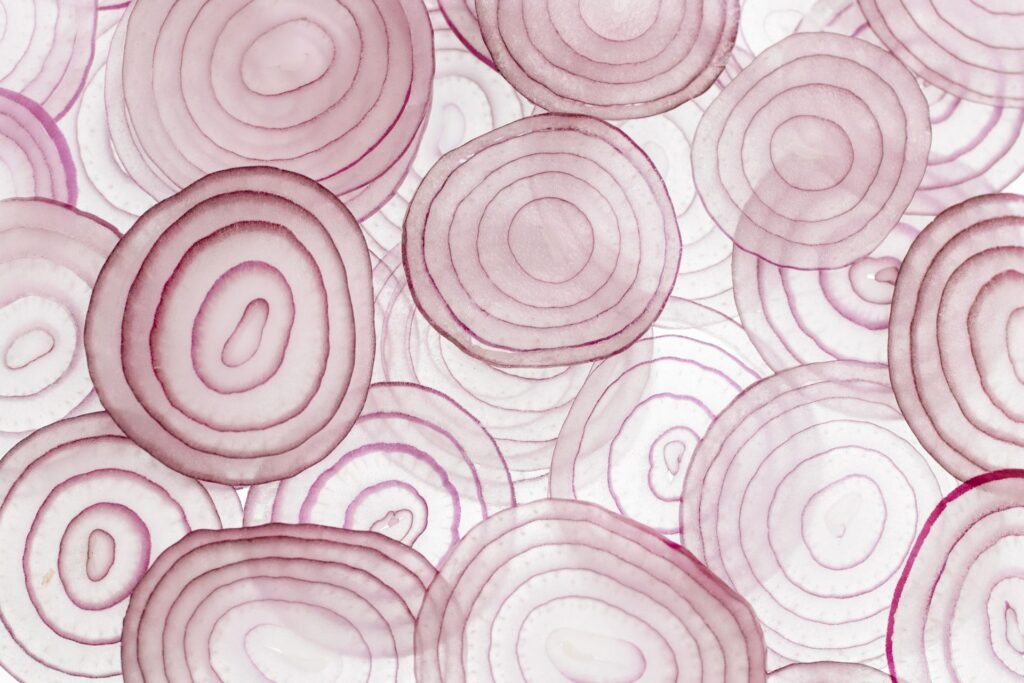
The shallowest layer consists of events and issues in our outer life. It consists of the people that we talk to, the news that we hear, the smells and sounds we experience as we walk outside. It is the sum of all the impressions we receive of the outer world. Some of these experiences do not affect us, for example, I may simply tune out music that does not appeal to me. But we may have a strong emotional response to other events or experiences, which takes us a level deeper.
The next level consists of the feelings and emotions that we are aware of. We may have deep emotions about the result of an election. Our personal relations may generate strong feelings—positive or negative, and changes in our living situation or employment may touch us deeply. Sometimes the strength of feelings is associated with the importance of a cause that can clearly be identified, but an emotional response may also be out of proportion with the event that triggered it.
At a deeper level live our ambitions, our hopes, and the principles that we seek to live by. These constitute the inner compass of our being. These ambitions and principles are a driver for the choices that we make, provided we pay attention.
The previous levels describe experiences and emotions that we are aware of. The next level consists of experiences and emotions that we are not aware of. We carry our past with us. Our past may contain positive experiences, but it can also be burdened by unhealthy familial or relational patterns, or by trauma that we experienced. We may suppress these negative experiences and emotions, but that does not mean that part of our past goes away. These experiences can still shape our behavior in the present and may even express in physical issues.
Beyond lie experiences that are often profound and that come unbidden. Examples are dreams with a deep message or mystical experiences. Such experiences can be revealing and sometimes are life changing. According to some religious texts, these experiences are layered themselves, and who knows if there is an end to the depth of these experiences?
For the present purpose we confine the discussion to these five layers. This is a simplified model that does not do justice to the complexity and richness of our being. One may ask where does religion or spirituality reside? That depends on the person. For some, the religious experience consists solely of outer events—gatherings and rituals—without further depth, while for others religion and spirituality involves a sense of belonging, principles to live by, and/or deep mystical experiences.
An interesting question is what our mind dwells on? Some of us are mostly focused on outer events and issues while not giving much thought to other levels of thinking, while others are deeply rooted in deeper levels of thinking while paying less attention to the more superficial levels of our existence. A truly integrated life gives space to all levels of being, one can argue that this integration is essential for living a life of integrity. Modern life with its electronic distractions tempts us to focus on outer events and experiences. The deeper levels do not clamor for attention, and one may need to still the mind to experience these deeper levels.
Related to the previous question it is relevant to ask what “mental food” you take in to nurture the different levels? Mental food consists of the books that we read, the movies that we watch, the conversations that we have, and the people we spend time with. Watching the news mostly fuels the level of events and experiences, along with emotions it generates. Reading religious or spiritual texts may enrich the deeper levels of existence. One of the reasons why the choice of “mental food” is important is that it can nurture different levels of our existence.
Our conversations tend to focus on the first two levels because speaking about the deeper levels of our existence makes us feel vulnerable. It is easy speak about world events and express judgements about these events. Sharing the values that we hold most deeply is much harder. And sharing profound experiences may expose us to scepsis and disbelief. In my experience, men are, in general, less inclined to share the deeper levels of their lives than women are; men tend to have ticker outer shells than women. I say this with some trepidation because this is a generalization that has many exceptions.
To which levels of your existence do you pay most attention? What mental food do you take in to nurture the different levels of your being? What levels do you focus on in your conversations with others? Does this depend on who you talk to? Are the different levels of your life well integrated, or do you compartmentalize them? As a coach I can help you get in touch with the deeper levels of your life. An onion consists of the combination of its layers. Likewise, the richness of our life consists of the contribution of all the layers in our life.